Beyond Salary: The Three Numbers Indian Banks Check for Home Loans
Discover the three financial numbers Indian banks check before looking at your salary slip, based on official Reserve Bank of India guidelines.
 CA PRAPHUL PUROHIT
"To secure a home loan in India, lenders prioritize three numeric metrics over your salary: a Credit Score of 750 or higher, a Fixed Obligation to Income Ratio (FOIR) under 50 percent, and a Loan to Value (LTV) ratio between 75 percent and 90 percent. Meeting these targets secures the lowest active interest rates."
The 3 numbers banks check before your salary
Amit walked into my office with a proud smile and a salary slip showing a neat monthly credit of 1.5 Lakh. He assumed securing property financing for his dream apartment in Pune would be a breeze. Two weeks later, the bank rejected his application. He was shocked. How could a high-income earner face a sudden rejection?
The truth is simple. Your salary slip tells only half the story.
Before banks even look at your monthly pay, they scrutinize three specific metrics. If these three numbers do not align with risk policies, your income statement becomes irrelevant. Let us break down these three numbers and see how they impact your borrowing journey.
Number 1: The Credit Score
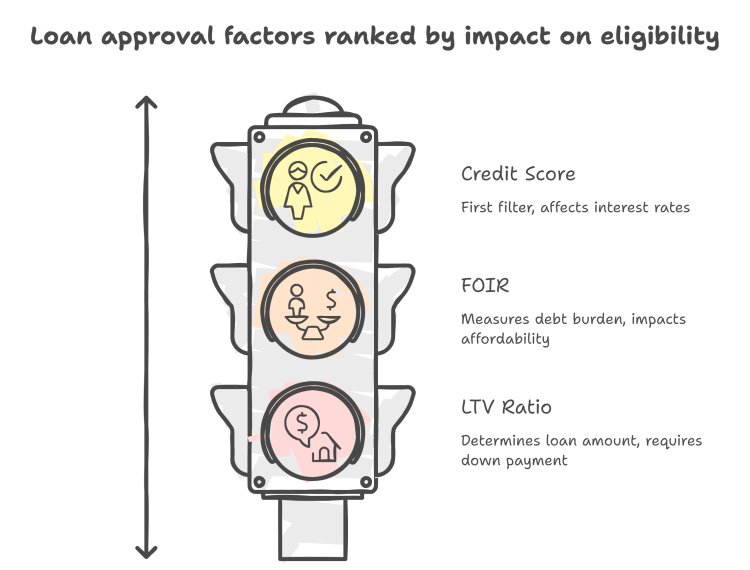
Your Credit Score is the very first filter. Most Indian lenders, including State Bank of India and HDFC Bank, want to see a CIBIL score of 750 or above.
Why does this matter?
A high credit score proves you pay debts on time. It also gives you access to the lowest interest rates. For example, SBI offers rates starting at 7.25 percent for borrowers with excellent credit scores, while those with lower scores might pay up to 8.40 percent.
If your score sits below 700, banks view you as high risk. Lenders might reject your application outright or charge a much higher rate.
Number 2: Fixed Obligation to Income Ratio (FOIR)
FOIR measures how much of your monthly income already goes toward existing debts, like car loans or credit card bills.
Banks want to ensure you have enough money left to live on after paying your home loan EMI. Most lenders cap your FOIR at 50 percent.
Let us look at Amit's case. He earned 1.5 Lakh but paid 90,000 monthly for a luxury car loan and personal debts. His FOIR was 60 percent. Even with his high salary, the bank refused to lend more because he exceeded the safe limit.
To lower your FOIR, clear your small outstanding debts before you apply for a home loan.
Number 3: Loan to Value (LTV) Ratio
The LTV ratio determines how much money the bank will lend you against the property value. The Reserve Bank of India sets strict limits on this ratio to protect the financial system. You can verify these guidelines on the official RBI website at rbi.org.in.
- For loans up to 30 Lakh, the maximum LTV is 90 percent.
- For loans between 30 Lakh and 75 Lakh, the maximum LTV is 80 percent.
- For loans above 75 Lakh, the maximum LTV is 75 percent.
If your dream home costs 1 Crore, the bank will lend you a maximum of 75 Lakh. You must arrange the remaining 25 Lakh as a down payment. If you do not have this down payment ready, your high salary cannot save the deal.
Your Next Steps
Before applying for property financing, run these checks yourself:
- Pull your credit report and aim for a score above 750. 2. Pay off active credit cards and small personal loans to lower your FOIR. 3. Save at least 20 percent to 25 percent of the property cost as a down payment.
Do you want to navigate this process without the stress? QuickHome Loan provides clear guidance to help you prepare your financial profile before you apply.
Sources: 1. Repo Rate Directives, Reserve Bank of India, rbi.org.in 2. Home Loan Interest Rates, State Bank of India, sbi.co.in
Key Points & Takeaways:
- A high salary slip alone does not guarantee home loan approval.
- You need a CIBIL score of 750 or above to access the lowest interest rates.
- Your total monthly debts (FOIR) must remain under 50 percent of your income.
- The RBI sets strict Loan-to-Value (LTV) limits, meaning you must prepare a solid down payment.
Frequently Asked Questions (FAQ)
Q: Can I get a home loan with a high salary but a low credit score?
A: No. A low credit score suggests a history of poor debt management. Lenders will either reject your application or charge a much higher interest rate, regardless of your high monthly income.
Q: What is a safe FOIR level for home loan approval?
A: Most banks consider a FOIR of 40 percent to 50 percent as safe. This means your total monthly debt payments, including the new home loan EMI, should not exceed half of your net monthly salary.
Q: How does the LTV ratio affect my down payment?
A: The LTV ratio determines how much the bank will fund. For properties above 75 Lakh, the maximum LTV is 75 percent, meaning you must pay the remaining 25 percent yourself as a down payment.